
XPOWER Water Damage Restoration in San Bernardino: A Homeowner’s Guide
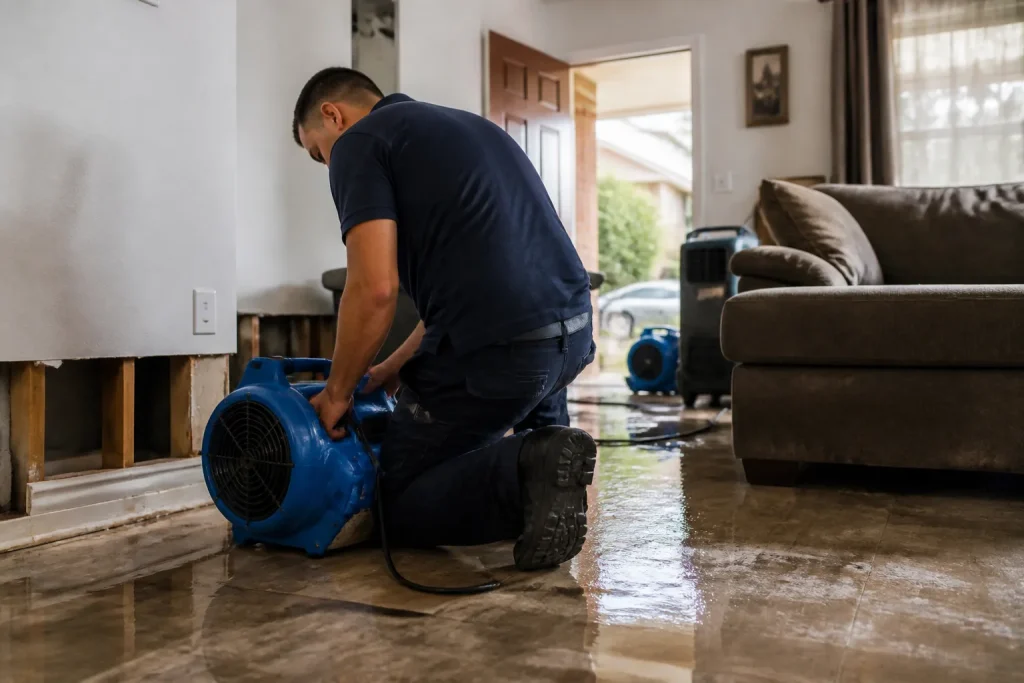
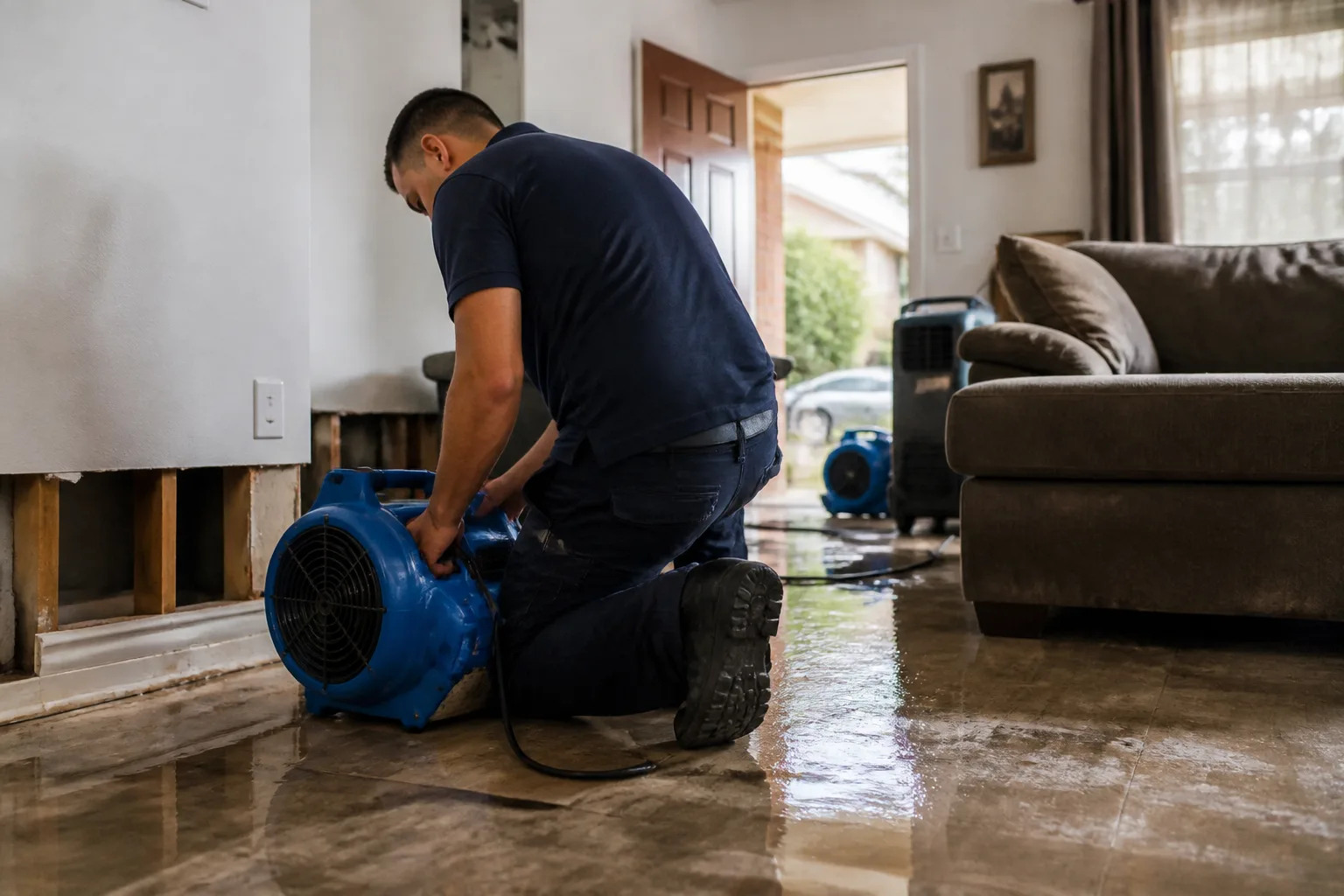
An XPOWER air mover sitting in the middle of a flooded room is doing almost nothing useful. The snail-shell design of these units is engineered to sit tight against baseboards at a 45-degree angle, forcing air through a vortex that pulls moisture from wall cavities and subfloor spaces. If you’ve had water damage in San Bernardino and someone parked fans randomly in the center of the floor, your drying job started wrong. Here’s what actually makes XPOWER equipment work in a real restoration scenario. And if you’d rather not manage any of this yourself, call San Bernardino Restoration Co at (877) 358-7678.
What XPOWER Equipment Actually Is
XPOWER manufactures professional air movers, dehumidifiers, and drying systems used in commercial water damage restoration. They fall into the pro-tier category alongside Dri-Eaz and Phoenix, which matters because consumer-grade fans from a hardware store can’t generate the static pressure needed to drive air into wet building materials. In water damage work, airflow is not a comfort feature. It’s the primary mechanism for evaporation.
The two XPOWER lines most commonly deployed in San Bernardino restoration jobs are the F-series axial air movers and the mini-storm centrifugal units. The F-series runs about 2,800 to 3,600 cubic feet per minute (CFM) depending on the model. Mini-storm units push roughly 2,000 CFM through a focused nozzle, which makes them the choice for tight spaces like closets, under cabinets, and wall cavities. The distinction matters because not every air mover fits every application.
We see equipment substitution happen a lot. A contractor shows up with two small fans for a 400-square-foot room and calls it a drying job. The IICRC S500 standard, which governs professional water damage restoration, specifies airflow requirements based on affected surface area. In broad terms, you need enough CFM to move the entire volume of air in the affected space multiple times per hour, directed specifically at wet surfaces. A few random fans don’t meet that bar.
San Bernardino Restoration Co uses XPOWER alongside Dri-Eaz and Phoenix units so the right machine goes to the right part of the job. That’s the difference between drying that takes three days and drying that takes seven with secondary damage.
The Equipment-to-Area Ratio: How Many Air Movers Do You Actually Need?
Industry guidelines for IICRC-compliant drying call for roughly 1 CFM of airflow per square foot of affected flooring and wall surface in a standard residential water loss. That’s a minimum baseline. Carpet over pad, saturated drywall, and hardwood all change the equation. A 300-square-foot bedroom with wet carpet and wet drywall two feet up might need 600 to 900 CFM of directed airflow to meet drying targets.
That means one XPOWER F-series unit per 250 to 400 square feet of affected surface, positioned correctly. If a contractor puts one air mover in a 500-square-foot living room and calls it good, the math doesn’t work. The room might feel dry to the touch, but moisture continues wicking through the pad, the subfloor, and the bottom plate of the wall framing.
Here’s what proper deployment looks like in practice:
- Air movers placed every 10 to 12 linear feet along affected walls
- Units angled 45 degrees toward the baseboard, not the middle of the room
- Focused nozzle units in corners, under toe-kicks, and in closets
- Airflow directed to create a circular pattern around the room perimeter
- Equipment counts documented with a drying plan that shows CFM coverage per affected area
In San Bernardino, where many homes were built in the 1950s through 1970s, you’re often dealing with plaster walls and hardwood over joist construction. Those materials dry differently than modern gypsum and OSB. Plaster holds water longer but also transmits it more slowly, so air mover placement becomes even more important. Angled units against plaster baseboards help pull moisture through the wall cavity without blasting the surface, which can cause cracking in older finishes.
Why Air Movers Without Dehumidifiers Just Move Moisture Around
Here’s the psychrometric principle most homeowners never hear explained. Air movers increase evaporation by blowing air across wet surfaces. That evaporated water goes somewhere. It lands in the air as humidity. If nothing removes that humidity from the space, the air reaches saturation, evaporation slows, and you end up with a warm, damp room where mold starts forming on every cool surface.
Dehumidifiers do the extraction work. LGR (low grain refrigerant) units pull moisture from the air and drain it out. In a proper drying setup, air movers and dehumidifiers work together as a system. The movers create evaporation. The dehumidifiers remove the resulting vapor. Run one without the other, and you get either wet air moving around or dry air with no evaporation happening.
This pairing is where a lot of restoration jobs go sideways. Homeowners rent a few fans from Home Depot, run them for a week, and the room still feels damp. Or a contractor shows up with dehumidifiers but only one air mover. The drying targets never get hit, and eventually someone’s using demolition to solve a problem that more precise airflow could have handled.
San Bernardino’s climate actually helps here. The Inland Empire runs dry most of the year, with ambient humidity commonly in the 15 to 30 percent range. That low humidity is an asset when handled correctly. With properly paired XPOWER air movers and LGR dehumidifiers, the dry outside air becomes part of the drying system through controlled ventilation. But it only works if someone’s measuring. We use documented moisture readings throughout the process, not guesswork, so we know when drying is done rather than when it feels done.
What Homeowners Should Check During a Drying Job
You don’t need to become a restoration tech to verify that a contractor is doing the work correctly. Here are five things to check when a crew starts a water damage drying job in your San Bernardino home:
- Equipment count matches the affected area. Ask how many square feet they’re treating and how many CFM of total airflow they’ve deployed. The answer should be specific, not “plenty.”
- Air movers are angled toward walls, not flat in the middle of rooms. This one detail separates trained technicians from whoever answered the phone.
- Dehumidifiers are running and draining. You should see water moving through a drain line or collection bucket filling. A dehumidifier that’s running but not draining isn’t doing much.
- Someone is taking moisture readings. This happens with a meter pressed against walls, floors, and baseboards. If nobody has a moisture meter on-site, they’re not documenting anything.
- There’s a drying plan. Even a one-page scope that lists equipment counts, affected areas, and daily moisture targets shows professional process. “We’ll run fans until it feels dry” is not a plan.
We pulled a job in the Del Rosa neighborhood last year where someone had run three XPOWER units for eleven days with no dehumidifier. The carpet felt dry on top. The pad underneath was saturated. The moisture meter read 34 percent in the subfloor. That’s the kind of thing that turns a $3,000 drying job into a $12,000 reconstruction if nobody catches it. The homeowner caught it because the baseboards started swelling.
San Bernardino Specifics: Why Local Conditions Change the Approach
The San Bernardino housing stock has characteristics that affect drying strategy. Many homes north of Highland Avenue have raised foundations with crawl spaces. Water from a supply-line break doesn’t just sit on the floor. It runs through the flooring and into the crawl space, where it sits against floor joists and insulation. Drying a crawl space requires a different equipment configuration than drying a slab-on-grade foundation in the south end of town.
Older neighborhoods like Arrowhead and Delmann Heights have significant numbers of homes with lath-and-plaster walls. Lath and plaster wicks water differently than drywall. It holds moisture in the wooden lath strips behind the plaster surface, and that moisture migrates upward through capillary action. XPOWER air movers positioned at baseboard level along those walls help pull the moisture down and out, but it takes longer than drywall drying. A contractor who quotes a three-day dry time on a plaster wall house probably hasn’t done many of them.
Then there’s the summer heat. San Bernardino regularly hits 95 to 105 degrees between June and September. Heat accelerates evaporation, which sounds helpful, but it also accelerates mold growth in wet materials. A water loss in August needs equipment running sooner than one in January. The window before secondary damage shortens significantly when interior temperatures are already high.
San Bernardino Restoration Co’s Water Damage Restoration in San Bernardino process accounts for these local variables because our technicians live and work here. We know when a crawl space needs an Injectidry system rather than a few more air movers. We know when to recommend controlled demolition because drying would take too long and cost more than replacement. That judgment comes from doing the work in this city, not from a playbook written for a different climate.
When XPOWER Air Movers Aren’t Enough
Air movers handle surface and near-surface moisture. They drive air across wet materials and accelerate evaporation. But some water damage situations require extraction first, and no amount of airflow fixes standing water in a wall cavity or under floor tile.
That’s where Injectidry systems come in. Injectidry attaches to wall cavities and under-floor spaces, creating negative pressure that pulls water out of enclosed areas. We use it in San Bernardino when water has gotten behind tile, under hardwood, or into wall cavities that open up through demolition. The system dries those hidden spaces without tearing out finished surfaces, which often means the difference between a repair and a remodel.
If water has been sitting for more than 48 hours, you may also be looking at mold. Air movers won’t fix that. Mold remediation is a separate process that involves containment, HEPA filtration, and removal of affected materials. San Bernardino Restoration Co handles Mold Remediation in San Bernardino as part of the same job when water damage has progressed that far. It’s another reason the first 48 hours matter so much, especially in summer heat.
And for homeowners dealing with smoke damage from the fires that touch the foothills in late summer, the Fire Damage Restoration in San Bernardino process is a different equipment set entirely. Air movers play a supporting role in odor mitigation and ash drying, but the core work involves HEPA vacuuming, soda blasting, and ozone or hydroxyl treatment. If you’re reading this because a fire sprinkler went off and you’re in the water damage phase of a fire job, both processes apply.
San Bernardino Restoration Co covers the full spectrum, so you’re not coordinating three contractors on one insurance claim. From extraction to clearance, one team handles the entire file. That keeps documentation consistent for your adjuster and keeps the job moving without finger-pointing between trades.
Questions to Ask Before You Sign
If you’ve had water damage in San Bernardino and you’re interviewing restoration companies, make them answer these questions in writing before you agree to anything:
- How many CFM of airflow will you deploy per affected area, and what’s the total affected square footage?
- What brand and model of dehumidifier are you using, and how many pints per day does it pull?
- Will you provide daily moisture readings for my file?
- Do you handle direct insurance billing, or do I pay out of pocket and chase reimbursement?
- What’s your process if drying targets aren’t met? Will you add equipment at no charge?
These questions filter out the companies that show up with two fans and a week of promises. You want a written scope before work starts, documented drying throughout, and a clear endpoint. We do all of that as standard practice, including photo documentation and direct adjuster coordination for insurance claims. You can call San Bernardino Restoration Co home to reach us. If you’re in the middle of a water emergency right now, call (877) 358-7678.
The Bottom Line
XPOWER air movers are serious equipment when they’re used correctly. The placement matters more than the brand name on the housing. Angled at baseboards, deployed in sufficient CFM per square foot, and paired with LGR dehumidifiers that actually drain, they dry a structure the way the manufacturer and the IICRC standard intend. Parked randomly in the middle of a room with no dehumidifier in sight, they’re just expensive floor fans doing nothing but circulating humid air.
Most homeowners in San Bernardino shouldn’t need to know any of this. That’s the job of the contractor you hire. But knowing it protects you from the ones who don’t. If you’re dealing with water damage right now, call San Bernardino Restoration Co at (877) 358-7678 for a free estimate. We’ll come out, assess what’s actually wet, and give you a written scope before any work starts.
Frequently Asked Questions
You need roughly 1 CFM of airflow per square foot of affected surface area, which typically means one XPOWER F-series unit per 250 to 400 square feet of wet flooring and walls. A professional drying assessment in San Bernardino should provide a specific equipment count tied to documented moisture readings, not a generic “we’ll bring a few fans” answer. Call (877) 358-7678 for a free estimate from San Bernardino Restoration Co.
You can rent equipment, but most homeowner rental setups fail because they don’t pair the fans with enough dehumidification. Air movers alone circulate moisture; they don’t remove it. Without LGR dehumidifiers drawing water out of the air, you’re extending the drying time and increasing mold risk. If the water affected more than a small spill, call a professional.
Most residential water damage in San Bernardino dries in three to five days when equipment is properly deployed and paired with adequate dehumidification. Plaster walls, hardwood flooring, and crawl spaces extend that timeline. A contractor should provide daily moisture readings so you can see the numbers dropping toward a defined dry standard. San Bernardino Restoration Co documents every reading for your insurance file.
Most homeowner policies cover professional water damage restoration including equipment costs, provided the water loss was sudden and accidental rather than ongoing neglect. Photo documentation and daily drying logs help your claim. San Bernardino Restoration Co works directly with insurance adjusters and provides the documentation they ask for, so you’re not stuck translating between the restoration crew and your carrier. Call (877) 358-7678 for a free estimate and we’ll walk you through the claim process.
Written by the team at San Bernardino Restoration Co, serving San Bernardino since 2016.
Need Damage Restoration Help?
Call San Bernardino Restoration Co — licensed & insured, here with fast after-hours help in San Bernardino.
(877) 358-7678