
Water Damage Restoration Pricing Breakdown: What San Bernardino Homeowners Pay in 2026
Two San Bernardino homeowners with nearly identical bathroom floods can receive quotes of $3,200 and $9,800 from different companies. The gap usually isn’t fraud. It’s one contractor billing by square foot and another billing Xactimate line items, and knowing which is which protects you. Water damage restoration in San Bernardino typically runs $2,800 to $7,500 for a contained Category 1 or 2 event in 2026, with sewage-related Category 3 losses and structural drying pushing past $12,000. Those are real ranges, not scare numbers, and the methodology behind them matters as much as the total.
If you’d rather not wade through estimating software to figure out your own quote, call (877) 358-7678 for a free assessment. Otherwise, read on. This is the pricing breakdown nobody hands you when you’re standing in an inch of water at 11 p.m.
Key Takeaways
- San Bernardino water damage jobs in 2026 fall into three price bands: $1,800 – $4,000 for Category 1 (clean water), $3,500 – $8,000 for Category 2 (gray water), and $6,000 – $15,000+ for Category 3 (sewage or floodwater).
- Xactimate line-item billing is what insurer adjusters expect to see. Flat-fee quotes often hide scope omissions or get rejected by carriers outright.
- The three line items most commonly inflated on San Bernardino invoices are equipment rental markups, antimicrobial application fees, and containment barrier charges.
- California CSLB rules require a contractor license for any restoration work exceeding $500 in combined labor and materials. Unlicensed operators are a known problem in the Inland Empire.
- A low quote that skips moisture mapping, drying logs, or post-remediation verification testing is not a deal. It’s a future mold claim waiting for the next rainy season.
How Much Does Water Damage Restoration Cost in San Bernardino in 2026?
The honest answer: it depends on the water category, the square footage of affected material, and whether the company bills by Xactimate line items or a flat rate. Here’s what we see across San Bernardino neighborhoods, from Verdemont to Arrowhead and down through the flats near Hospitality Lane.
| Damage Category | Typical Square Footage | 2026 San Bernardino Price Range |
|---|---|---|
| Category 1 (clean water: supply line, sink overflow) | 100 – 400 sq. ft. | $1,800 – $4,000 |
| Category 2 (gray water: washing machine, dishwasher discharge) | 200 – 600 sq. ft. | $3,500 – $8,000 |
| Category 3 (sewage, storm flood, San Bernardino wash overflow) | 300+ sq. ft. | $6,000 – $15,000+ |
Those numbers assume standard drywall, baseboard, and flooring materials with professional extraction and structural drying. A 400-square-foot Category 1 loss in a single-story home off Del Rosa typically lands around $3,200 to $3,800 when billed correctly. The same footprint with sewage contamination and required disposal of carpet, pad, and lower drywall cuts pushes toward $9,000 before rebuild, and that’s before you count the peace-of-mind testing afterward.
San Bernardino’s older housing stock matters here too. Homes built before 1990 in the central city and near the 215 corridor often have plaster-and-lath walls instead of modern drywall. Plaster dries slower, holds contaminants differently, and costs more to remediate properly. Contractors who don’t account for that in their first walkthrough are guessing, and their numbers will shift on day three when the moisture readings haven’t moved.
Xactimate Explained: Why It Controls Your Quote
Xactimate is the estimating software used by nearly every major insurance carrier in California. It generates line-item pricing based on regional labor rates, material costs, and equipment time for each individual task: extraction per square foot, dehumidifier rental per day, antimicrobial application per square foot, containment barrier per linear foot, and dozens more.
When a restoration company in San Bernardino bills through Xactimate, your adjuster can verify each line against regional pricing benchmarks. When a company hands you a single number scrawled on a work order, the adjuster has nothing to approve, and you have no way to know whether $6,400 is fair or $2,000 too high.
We’ve seen this play out in the Crestline and Lake Arrowhead area, where high-elevation homes with crawlspaces and steep access drive pricing above the San Bernardino valley floor. A Xactimate estimate for the same 300-square-foot Category 2 loss can run 18 to 25 percent higher up there because of equipment transport time and access constraints, and the line items explain exactly why. A flat-fee quote just looks expensive with no explanation, or suspiciously cheap with no scope.
The takeaway for any San Bernardino homeowner: if your contractor cannot or will not provide a line-item breakdown that matches Xactimate categories, you are not comparing apples to apples. You’re trusting a number, not verifying it. That’s the difference between an informed purchase and a hope.
The Three Line Items That Get Inflated on San Bernardino Invoices
Not every restoration bill is inflated, and the vast majority of IICRC-certified companies in the Inland Empire charge what the work requires. But there are three specific line items we tell homeowners to look at closely, because they’re the ones most often padded when a contractor thinks the client won’t read the detail.
1. Equipment rental markups
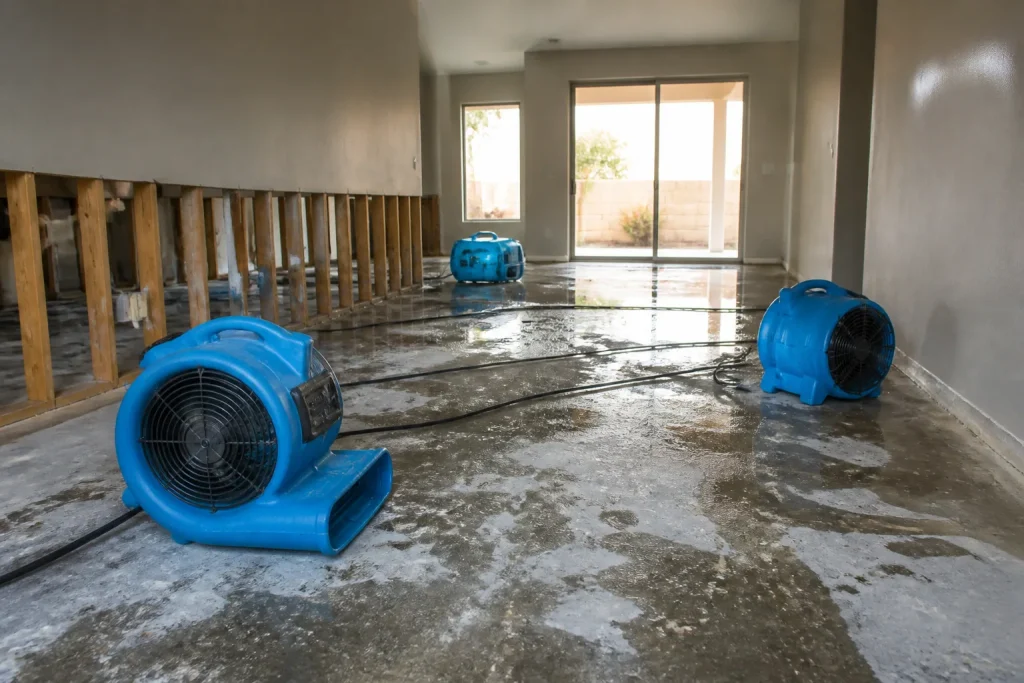
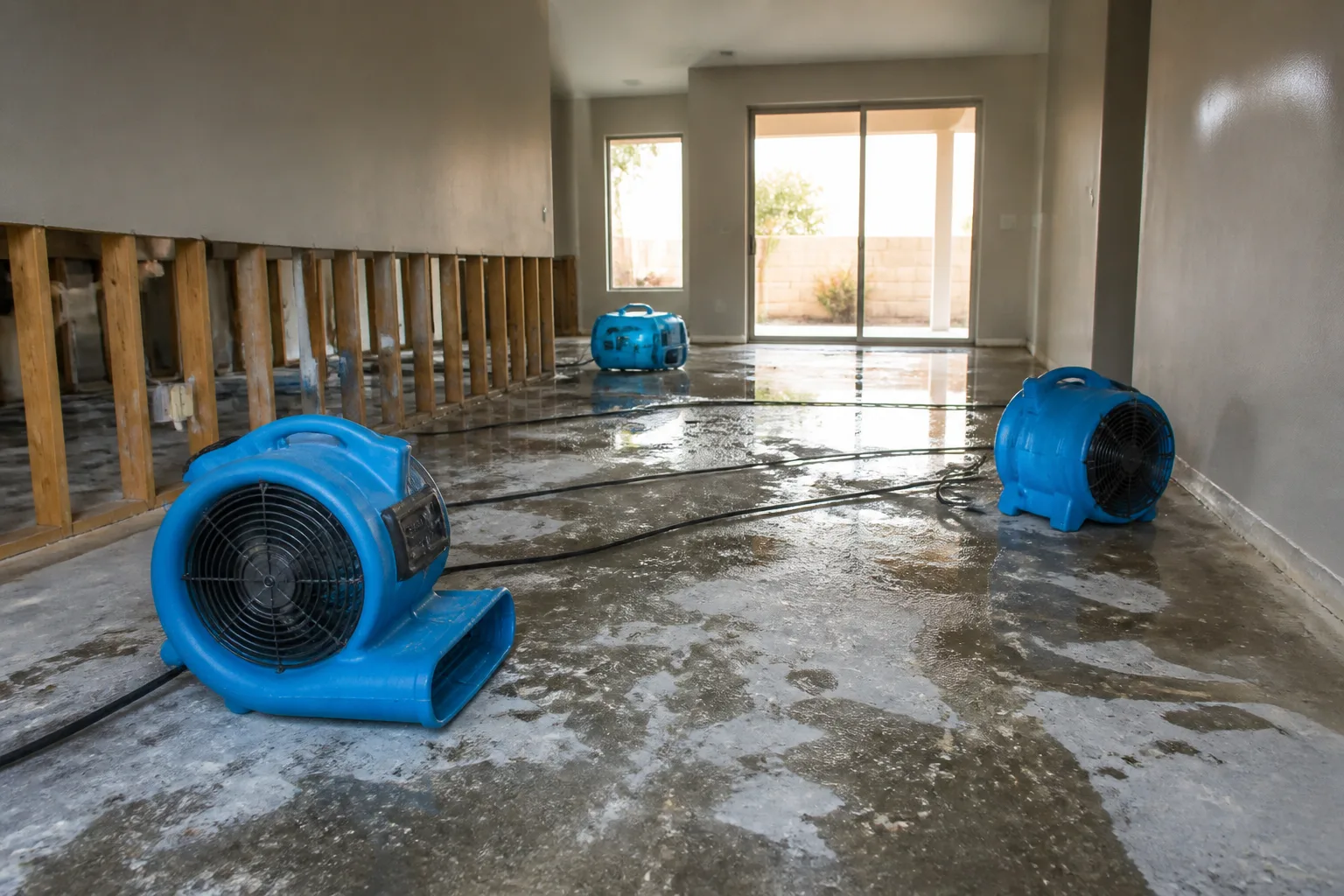
Commercial dehumidifiers like Dri-Eaz and Phoenix units don’t rent for $180 a day from a restoration supply house; they run $60 to $90 per unit per day in the San Bernardino market. If your invoice shows three dehumidifiers at $140 a day each for five days, that’s a $750 markup over market. Equipment should be line-itemed at or near actual rental cost. Ask to see the daily rate broken out per unit, not bundled into a single “drying equipment” charge.
2. Antimicrobial application fees
Applying an EPA-registered antimicrobial to affected surfaces is standard on Category 2 and 3 losses. What’s not standard is billing it as a separate line at $1.50 to $3.00 per square foot when it’s already included in the per-square-foot mitigation rate. If you see antimicrobial applied as an add-on beyond the initial scope, ask why. On clean-water Category 1 jobs, it often shouldn’t be a separate charge at all.
3. Containment barrier charges
Containment, typically 6-mil poly sheeting with negative air pressure, protects unaffected rooms from airborne particulate during demolition and drying. It’s legitimate and necessary on Category 3 losses. But it’s billed by the linear foot, and vague invoices with “containment, job-wide” are where padding hides. A 400-square-foot confined area might legitimately run $300 to $600 for containment. If your bill shows $1,800 with no dimensions attached, ask for the math.
We pulled one invoice apart for a homeowner near San Bernardino High School last fall where “containment and barriers” was listed as a single $2,400 line. The actual space contained was a 10-by-8 hallway. That’s the kind of discrepancy that makes adjusters push back and leaves homeowners holding an open balance.
California CSLB Rules: Who Can Legally Bill You in San Bernardino
California Contractors State License Board rules are clear: any restoration work combining labor and materials above $500 requires a valid contractor’s license in the appropriate classification. Water damage restoration in San Bernardino typically falls under a C-61/D-64 (Non-Structural Fire and Water Restoration) license or a general B license with restoration endorsements.
Why this matters for pricing: unlicensed operators can’t pull permits, can’t carry the workers’ compensation coverage insurers expect, and can’t legally enforce a contract over $500. They also tend to underbid licensed companies by 20 to 40 percent, then either abandon jobs, cut scope, or demand cash payments midway through drying.
San Bernardino County requires a business license for restoration contractors operating within city limits, and the city of San Bernardino adds its own licensing verification step for any contractor doing structural work. When you’re comparing quotes, verify the contractor’s CSLB license number against the state database. It takes two minutes and it’s the single fastest way to eliminate the bottom tier of pricing that shouldn’t be in your decision set anyway.
IICRC certification is separate from state licensing. The IICRC trains and tests technicians on the science of drying: psychrometry, moisture mapping, equipment sizing, and documentation standards. A company can hold a CSLB license without a single IICRC-certified tech on staff. For water damage specifically, we’d argue the certification matters as much as the license when you’re trusting someone to decide whether your wall cavities are actually dry.
When a Low Quote Is the Most Expensive Option
A $1,900 quote on a job where everyone else is at $4,500 should trigger the same skepticism as a $9,800 quote on a job where everyone else is at $5,000. Neither number is automatically wrong, but both require interrogation. The low quote usually wins by omitting three specific scope items that are invisible until the damage reappears.
Moisture mapping. Before extraction begins, a qualified technician should map the affected area with penetrating and non-penetrating moisture meters, documenting readings on a floor plan. If your quote doesn’t include this step, the contractor is extracting water they haven’t fully located. Water travels laterally through subfloor, wicks up drywall, and hides in wall cavities. Mapping finds it. Skipping it means drying what’s visible and leaving what’s not.
Drying logs. Insurers and IICRC protocols require daily moisture readings throughout the drying process. These logs track the drying curve and prove the job is complete when the readings say it’s complete, not when the rental period on the dehumidifiers ends. A restoration company that doesn’t keep drying logs is either not monitoring the job or not documenting what they’re doing. Neither is acceptable when mold starts growing at day three.
Post-remediation verification. After drying, the affected areas should be re-tested to confirm moisture content has returned to pre-loss baseline and no elevated moisture remains in hidden cavities. Companies that skip this step save $150 to $400 on the job. Homeowners who skip this step sometimes pay $8,000 to $15,000 for mold remediation twelve months later when the retained moisture blooms.
We worked a loss in the North Park area of San Bernardino where a previous contractor had “dried” a kitchen after a dishwasher leak. No moisture mapping, no logs, no verification. The homeowners got a $1,700 bill and a clean-looking kitchen. Six months later, the baseboards were black and the subfloor under the dishwasher had delaminated. Their final remediation bill was $11,400. The cheap quote would have been cheaper at $4,500, done right the first time.
When to call a pro: any water event that has soaked into porous materials and cannot be fully extracted with a shop vac within 24 to 48 hours. San Bernardino’s summer heat accelerates microbial growth, and our winter Santa Ana cycles create exactly the humidity swings that hide incomplete drying until spring. If you see water wicking up drywall, if the affected area covers more than a single room, or if the water source is anything but a clean supply line, call (877) 358-7678 before you start pulling baseboards yourself.
Related services in San Bernardino: if you’re reading this because water is involved, Water Damage Restoration in San Bernardino walks through our full process from extraction to structural drying. If you’re reading this because the water happened months ago and you smell something musty, Mold Remediation in San Bernardino covers what happens after water sits too long. And for the worst-case scenario, Fire Damage Restoration in San Bernardino explains how the same line-item pricing discipline applies when the loss involves smoke and heat, not just water.
Real Numbers From Real San Bernardino Jobs
Here’s what actual invoiced jobs look like when billed through Xactimate in the San Bernardino market, 2026 rates. These are composites from jobs we’ve worked and reviewed, rounded to protect client privacy.
- Single bathroom, Category 1, 120 sq. ft. Supply line burst overnight. Extraction, baseboard removal, drywall cut at 24 inches, five days of drying with one Dri-Eaz dehumidifier and two Phoenix air movers, moisture mapping and drying logs included. Final bill: $2,940.
- Kitchen and hallway, Category 2, 340 sq. ft. Dishwasher discharge line failure. Gray water extraction, containment, antimicrobial application, drywall removal to 24 inches in kitchen, two dehumidifiers and six air movers for seven days, post-remediation verification. Final bill: $6,850.
- Finished basement, Category 3, 500 sq. ft. Sewage backup through a floor drain near the 215 corridor. Full containment with negative air, sewage extraction and disposal, carpet and pad removal, drywall cut at 48 inches in affected areas, Injectidry wall-cavity drying units on two walls, antimicrobial application, five days of structural drying, clearance testing. Final bill: $13,600 before rebuild.
The Injectidry system on that basement job is worth understanding because it changes pricing in the other direction. Those units dry wall cavities from the inside without tearing out finished surfaces, which means fewer demolition hours and less reconstruction cost on the back end. The equipment line item runs higher during the drying phase, but the total project cost often lands 15 to 20 percent lower than full tear-out drying. That’s the kind of line-item tradeoff Xactimate makes visible.
San Bernardino’s elevation and climate show up in these numbers too. Homes in the foothills around California State University San Bernardino run cooler and damper in winter, which extends drying times by a day or two compared to the flats. Homes on slab foundations under the flight path dry differently than raised-foundation homes in the older central city. A competent estimator builds those variables into the line items. A lazy one averages them out of a flat fee and hopes the job goes easy.
How to Read a Water Damage Quote Without a Remediation Degree
You don’t need to memorize Xactimate’s price catalog to protect yourself. You need to ask five questions, and you need to listen to whether the answers line up with what we’ve covered here.
- Is this a Xactimate estimate or a flat-fee quote? If flat-fee, ask for the line-item breakdown anyway. A legitimate company can produce one in under an hour.
- Does the scope include moisture mapping before extraction? If not, ask why. Mapping should be included on any job over a single bathroom.
- What’s the daily rental rate per dehumidifier and air mover? In San Bernardino, expect $55 to $95 per day per dehumidifier and $25 to $40 per day per air mover. Higher than that demands justification.
- Are drying logs included, and will I receive copies? Insurers expect them, IICRC protocol requires them, and you’re paying for the documentation whether the contractor provides it or not.
- Is post-remediation verification included in the final invoice? If it’s an add-on, factor it in. If it’s not mentioned at all, that’s your red flag.
We’ve answered these questions on dozens of quotes written by other companies across San Bernardino, from Highland to Loma Linda to the unincorporated county pockets around Muscoy. The patterns hold. Companies that bill Xactimate line items welcome the questions. Companies that bill flat fees get defensive or vague. That tells you most of what you need to know before you sign anything.
The Bottom Line
Water damage restoration pricing in San Bernardino is predictable when you know what you’re looking at. Category 1 clean-water losses run $1,800 to $4,000 for typical residential footprints. Category 2 gray-water losses run $3,500 to $8,000 depending on square footage and affected materials. Category 3 sewage and flood losses start around $6,000 and climb past $15,000 when structural drying and containment are done correctly. The variance within each band comes down to billing methodology, scope inclusions, and whether the company documents its work to IICRC standards or guesses.
Get a line-item estimate. Verify the CSLB license. Scrutinize equipment rates, antimicrobial charges, and containment lines. And if the quote looks too good to be true for the scope described, check what’s missing before you celebrate the savings. In our experience at San Bernardino Restoration Co home, we’d rather walk you through the line items up front than explain a mold bloom later.
If you’re in San Bernardino and need help now, we offer free estimates with full line-item breakdowns on every job. Call (877) 358-7678 and we’ll walk the loss with you, map the moisture, and put the numbers in writing before any work starts. Restoration, not just cleanup.
Frequently Asked Questions
Most of the variance comes down to billing methodology. Companies using Xactimate line items bill each task separately at regional rates, which produces higher, more detailed quotes. Companies using flat-fee pricing bundle everything into a single number that may skip required scope items like moisture mapping, drying logs, or containment. A $3,200 quote and a $9,800 quote for the same bathroom flood usually reflect different scopes, not different levels of greed. Compare line items, not totals. Call (877) 358-7678 if you want help comparing quotes on a current loss.
Most homeowner policies cover sudden and accidental water damage from sources like burst supply lines, appliance failures, and storm intrusion. They typically exclude gradual leaks, lack of maintenance, and groundwater flooding unless you carry separate flood insurance. Restoration companies that document with Xactimate line items and daily moisture readings make the adjuster’s job easier, which tends to speed up approval. If you’re dealing with an adjuster now, ask your contractor whether they bill Xactimate, because the answer will affect your claim timeline.
For a typical Category 1 or 2 residential loss, extraction happens on day one and structural drying runs three to seven days depending on square footage, materials, and San Bernardino’s seasonal humidity. Category 3 sewage losses add containment setup and disposal time, typically extending the full job to seven to twelve days before rebuild. Drying logs determine when the job is actually complete, not a calendar date. If a contractor promises everything dry in two days on a large loss, ask for the moisture readings that support it.
Water damage restoration pricing covers extraction, drying, antimicrobial treatment, and documentation of the drying process. Mold Remediation in San Bernardino pricing covers containment, removal of colonized materials, HEPA vacuuming, antimicrobial application, and clearance testing. The two often overlap on losses where water sat for 48 hours or more before extraction started. Mold remediation typically runs 30 to 60 percent higher per square foot than water restoration because of the containment and clearance testing requirements. If you had water damage months ago and now see staining or smell mustiness, the pricing conversation has shifted from restoration to remediation.
Written by the team at San Bernardino Restoration Co, serving San Bernardino since 2016.
Need Damage Restoration Help?
Call San Bernardino Restoration Co — licensed & insured, here with fast after-hours help in San Bernardino.
(877) 358-7678