
Emergency Water Damage Restoration Near Me: What San Bernardino Homeowners Should Do First
If you’re searching “emergency water damage restoration near me” in San Bernardino, the single most important move is to shut off your HVAC system before you touch a single towel. Then cut the water source, kill the power to affected rooms, and call a certified restoration team that dispatches actual technicians, not an answering service. Those first 60 minutes shape your repair bill more than any decision you’ll make afterward.
If you’d rather not manage the first hour on your own, call San Bernardino Restoration Co home at (877) 358-7678 and we’ll walk you through it while a crew heads your way.
What Actually Happens in the First Hour: The Sequence That Stops Compounding Damage
Most San Bernardino homeowners do the intuitive things first: grab towels, move furniture, maybe call a plumber. Intuitive is expensive. Water damage doesn’t spread in a straight line. It migrates through drywall, wicks up baseboards, travels under flooring, and saturates the air. Every minute a structure stays wet, the moisture front moves deeper into materials that were dry an hour ago.
Here’s the sequence we train our technicians to use, and it’s the same sequence we walk homeowners through on the phone before the truck arrives:
- Shut off the HVAC system at the thermostat and the breaker. A running air handler pulls moisture and whatever’s in the water, sewage, bacteria, mold spores, into the ductwork and distributes it through every room. This is the step almost everyone misses.
- Stop the water source. If it’s a burst supply line, shut the main valve. If it’s an appliance, turn the supply valve behind it. If you can’t identify the source, shut the house main valve. The water department can also shut the meter if the main won’t budge.
- Cut power to the affected area at the breaker panel. Water and electricity do not negotiate. If the panel is wet or you can’t reach it safely, stay out and wait for the restoration crew.
- Photograph everything before you move anything. We’ll get into that below, but the key word is before.
- Call the restoration company, then call the plumber. This order matters more than you’d think.
We pulled a job out of a split-level off Del Rosa Avenue last fall where the homeowner had spent 45 minutes using a household shop vac on a ruptured water heater feed line. The vac pulled maybe 12 gallons. In that same 45 minutes, water had saturated the subfloor under the laundry room and started wicking into the adjacent hallway. The extraction time doubled, and the drying window stretched from three days to six. The vac wasn’t useless, but it was the wrong priority.
Why Calling a Plumber First Delays the Restoration Clock
A plumber fixes the source. A restoration company mitigates the damage. In a water event, you need both, but the order you call them in has consequences.
Here’s what happens when San Bernardino homeowners call a plumber first and wait: the plumber arrives, confirms the source, makes the repair, and leaves. Nobody extracts the standing water. Nobody places air movers or dehumidifiers. The moisture stays exactly where it was, soaking deeper into the structure. Plumbers do important work, but running water extraction and drying equipment is not their job, and they won’t have a wood floor drying system or a wall-cavity injector on the truck.
The smarter play is simultaneous: get the restoration company rolling while you or the dispatcher lines up the plumber. Our crews coordinate with plumbers on site all the time. The plumber handles the source repair. We handle extraction, drying, and the documentation your insurance adjuster needs.
If the source is obvious, a burst washing machine hose or a visibly weeping water heater, you can sometimes skip the plumber entirely and let the restoration crew shut the supply. If the source is hidden, a slow leak inside a wall cavity or under a slab, a professional leak detection service becomes part of the equation. Our technicians can map moisture migration with Water Damage Restoration in San Bernardino protocols and pinpoint where the water is traveling, even when the entry point isn’t visible.
Documenting the Damage Before You Touch It: What an Adjuster Actually Wants
Insurance adjusters process water claims by evaluating evidence. That evidence degrades the moment you start moving wet belongings, pulling up carpet, or cutting drywall. Your phone camera is the most valuable tool you own in the first hour, and the framing of your photos determines how smoothly the claim goes.
Here’s the documentation sequence we recommend to homeowners before any cleanup begins:
- Wide shots first. Stand at the doorway of the affected room and shoot the full scene from all four corners. This establishes scope and context.
- Mid-range shots of the source. The burst pipe, the failed appliance, the ceiling stain where water came through. If the source is visible, document it from multiple angles.
- Close-ups of water lines on walls. Drywall shows a visible watermark where moisture has wicked upward. That line tells the adjuster how deep the water penetrated, and it doubles as a reference point for drying progress.
- Contents, not just structure. Photograph wet furniture, soaked boxes, affected rugs, anything with visible water contact. The adjuster needs to see what was damaged before it moves.
- Serial numbers and model plates on affected appliances. This sounds tedious, but it makes the contents portion of the claim dramatically easier to substantiate.
We’ve watched claims stall because homeowners threw out damaged contents before photographing them. We’ve also watched claims get approved faster because the homeowner had a clear photo sequence from minute one. The documentation habit doesn’t cost you anything but five minutes.
What Not to Do: The Three Mistakes That Compromise the Job and the Claim
Bad advice during a water emergency is free, abundant, and usually delivered with total confidence. A well-meaning neighbor or an online forum will tell you to set up box fans, wet-vac the water yourself, or hit visible mold with bleach. Here’s why those specific moves create problems in a San Bernardino water event:
Box fans and household fans are not structural drying equipment. A box fan moves air across the surface of a material. It does not create the vapor pressure differential necessary to pull moisture from inside drywall, wood, or concrete. Worse, if the water is from anything other than a clean supply line, running a fan spreads contaminated particulate before the source water has been extracted. The right tool is a high-velocity air mover like a unit from XPOWER or B-Air, positioned after extraction to create the airflow pattern that actually drives evaporation. That’s equipment we roll into the job, and it’s calibrated to moisture readings, not guesswork.
Household wet-vacs are fine for a small spill, not for a flooring event. A standard shop vac pulls surface water. It doesn’t extract water from carpet padding, from behind baseboards, or from between floor layers. If the water is Category 3, meaning it contains sewage, storm runoff, or anything that qualifies as grossly contaminated, using a household vac turns that vac into a contamination vector. The water gets aerosolized, filters become biohazards, and you’re spreading what you’re trying to contain. Professional extraction uses truck-mounted or portable units built for high-volume recovery, and technicians wear appropriate PPE while it happens.
Bleach on visible mold is the equivalent of painting over a termite problem. Bleach kills surface mold on non-porous materials. On drywall, wood, or carpet backing, the mold penetrates below the surface where bleach can’t reach, and the water content in bleach can actually feed deeper mold growth. Mold in a water-damaged home is almost always an indicator of hidden moisture, and the fix is drying the structure, not painting the surface. That’s when the conversation shifts to our Mold Remediation in San Bernardino work, which follows IICRC protocols for containment, removal, and clearance testing.
If any of these situations describe what you’re looking at, call (877) 358-7678 before you grab the bleach bottle. The phone call is free. Undoing a bleach treatment is not.
What Legitimate 24/7 Dispatch Looks Like in San Bernardino (vs. an Answering Service)
“Emergency water damage restoration near me” is a high-stakes search, and San Bernardino has no shortage of companies bidding on it. The problem is that some of those listings route to answering services that take a message and promise a call back the next morning. By morning, your subfloor has had eight more hours to saturate, and the drywall wicking has climbed another six inches.
A legitimate emergency restoration dispatch looks like this:
- You reach a live human who can make decisions. Not a call center reading from a script. Someone who can dispatch a crew, answer a technical question, and give you a straight answer about arrival windows.
- You get an arrival window from a real person, and the crew arrives within it. San Bernardino restoration companies running true emergency service will give you a range: “We’re 45 minutes out,” or “We have a job in Rialto right now and can be to you in 90 minutes.” You should never hear “sometime tomorrow morning.”
- The technician on the phone gives you instructions for the next 45 minutes. A real dispatcher walks you through the basics: shut the HVAC, cut power, don’t use a household vac, photograph the damage. An answering service can’t do that.
- The crew arrives with professional extraction and drying equipment on the truck. Dri-Eaz or Phoenix dehumidifiers, XPOWER or B-Air air movers, moisture meters, the real tools of the trade, not a box fan and a mop bucket.
We answer our phones around the clock, and the person on the other end has been trained to talk you through the first steps while a crew is dispatched. You shouldn’t have to be a restoration expert at 2 a.m. You just need to know the urgent moves, and the person on the phone should be able to give them to you.
When to call a pro: If the water has been standing for more than a few hours, if it came from anything other than a clean supply line, if it’s affecting multiple rooms, or if you can see water staining on walls or ceilings, this is no longer a DIY situation. The extraction and drying work requires professional equipment and a documented moisture-mapping process. We’re Fire Damage Restoration in San Bernardino specialists as well, but water is the most common emergency we respond to, and the first-hours protocol matters more than anything else on the job.
How Professional Drying Actually Works (and Why It’s Restoration, Not Cleanup)
A mop and a towel remove water you can see. Restoration removes water you can’t. The difference is why a “dry” floor can still harbor moisture that rots the subfloor, warps the joists, and feeds mold growth behind the baseboard.
Professional structural drying follows a sequence that starts with extraction and ends with documented moisture readings at baseline. Here’s what that sequence looks like in practice:
Extraction first. Standing water leaves first through high-volume extraction. Carpet gets extracted with weighted extraction tools. Hard surfaces get squeegeed and extracted. Nothing gets dried until the standing water is gone.
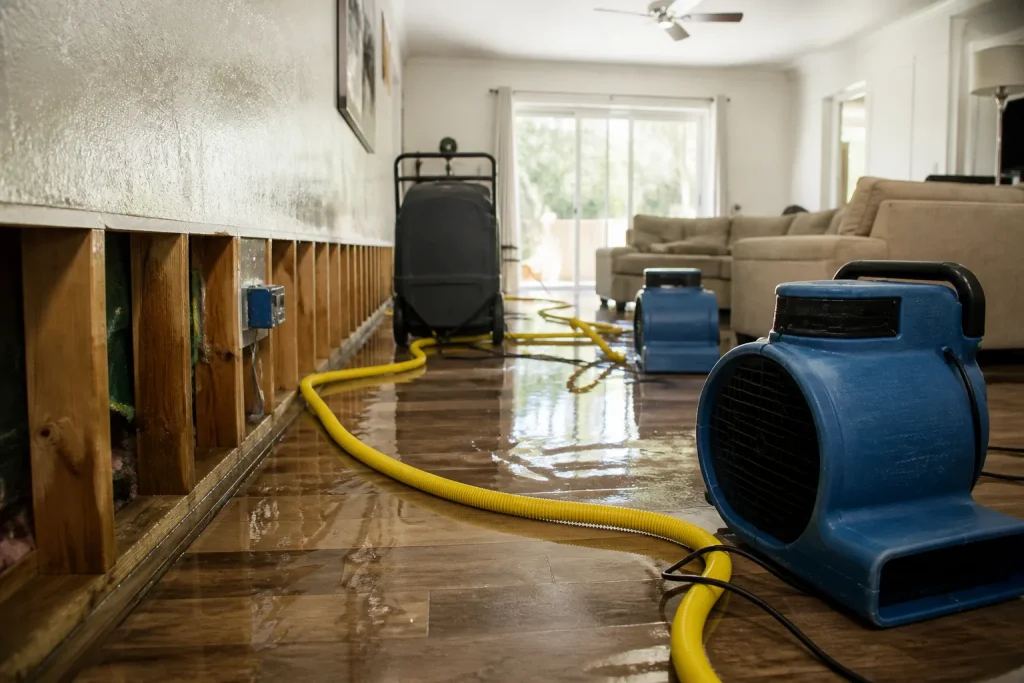
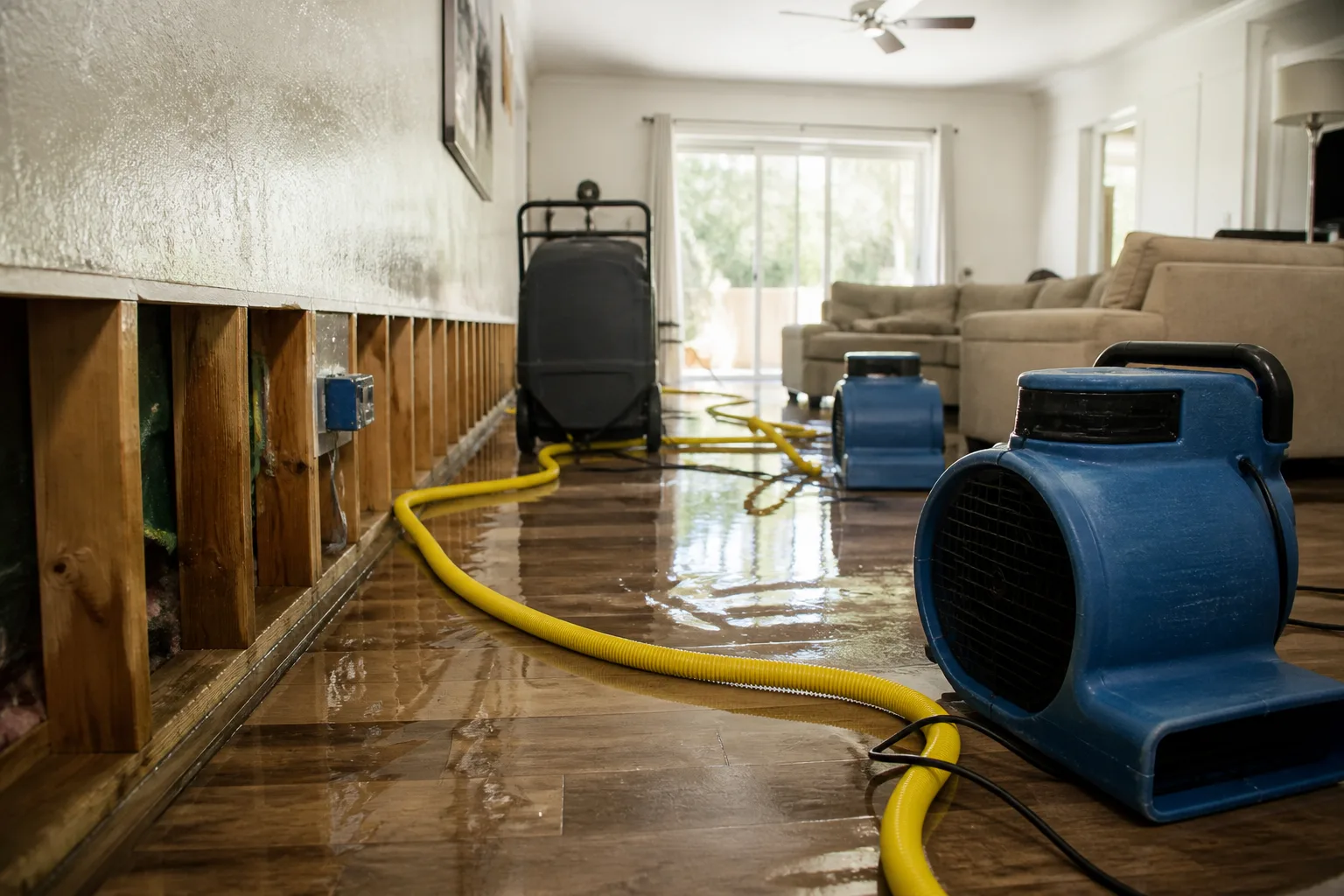
Airflow engineering. High-velocity air movers get positioned to create a turbulent airflow pattern across every wet surface. The goal isn’t just moving air, it’s creating the evaporation rate necessary to drive moisture out of materials at the right pace. Too fast, and wood floors cup or crack. Too slow, and mold gets a head start.
Dehumidification matched to the moisture load. A Dri-Eaz or Phoenix dehumidifier calculates grains of moisture in the air and removes water vapor faster than the structure releases it. Running a dehumidifier without proper airflow does almost nothing. Running air movers without dehumidification just moves wet air around. The two work together, and the equipment has to be sized for the affected square footage.
Wall-cavity and hard-to-reach drying with Injectidry. When water gets behind walls, under cabinets, or between floor layers, surface drying won’t reach it. Injectidry systems push dry air directly into wall cavities and negative-pressure mat systems pull moisture out of hardwood floors. This is the difference between drying a wall in place and tearing out every wet surface. In San Bernardino homes with plaster walls, mid-century hardwood, or custom cabinetry, Injectidry saves the building materials and your budget.
Daily moisture readings, not guesswork. We document moisture content with penetrating and non-penetrating meters every day until the structure returns to its dry standard. That documentation goes to your adjuster, so the insurance claim matches the actual extent of the drying job.
That’s the Water Damage Restoration in San Bernardino standard we operate under: IICRC-certified protocol, professional-grade equipment, and a written record of every reading. Restoration, not just cleanup.
San Bernardino-Specific Considerations: Climate, Construction, and the Wet Season
San Bernardino’s damage pattern differs from coastal Southern California. The dry inland air helps in some ways, it pulls moisture out naturally, but it also masks problems. A slab leak in a Riverside home might show visible warping faster because the humidity is higher. In San Bernardino, the ambient air is dry enough that the surface of a wet floor can feel deceptively stable while the subfloor underneath is saturated.
The other San Bernardino factor is the age and construction of the housing stock. A significant portion of the city’s homes date from the post-war boom through the 1970s, with plaster walls, solid hardwood flooring, and concrete slabs. Water behaves differently in those materials than it does in modern drywall-and-engineered-wood construction. Plaster wicks slowly but holds moisture stubbornly once saturated. Solid hardwood swells and cups if the moisture removal rate is too aggressive, then cracks if it’s too slow. Concrete slabs hide water migration under the slab until it emerges somewhere else entirely.
Winter storms in San Bernardino bring a predictable spike in roof leaks, window infiltration, and drainage failures. The spring and summer months see more supply line failures and water heater ruptures as aging plumbing components finally give out under temperature cycling. The point is that the geographic and seasonal variables are real, and a local crew familiar with them makes faster, better decisions on site.
The Bottom Line
The first hour after water damage is when the bill gets set. Shut off the HVAC, cut the water and power, photograph everything, and call a restoration company that dispatches real technicians immediately, not an answering service promising a callback. Skip the box fans, the household wet-vac, and the bleach. Each of those moves either spreads contamination or masks moisture that needs professional drying.
If you’re in San Bernardino and dealing with water in your home right now, San Bernardino Restoration Co offers free estimates. Our IICRC-certified technicians roll with Dri-Eaz dehumidifiers, XPOWER and B-Air air movers, and Injectidry wall-cavity drying systems, and we document every moisture reading for your adjuster. Call (877) 358-7678 and you’ll talk to a real person who can walk you through the next 45 minutes while a crew gets dispatched.
Frequently Asked Questions
A legitimate emergency restoration company dispatches immediately and gives you a real arrival window, often within 45 to 90 minutes depending on current job load. If you’re told “sometime tomorrow morning,” you’re talking to an answering service, not an emergency dispatcher. Call (877) 358-7678 for a straight answer on current response times.
Most standard homeowners policies cover sudden and accidental water damage, such as a burst pipe or appliance failure, but not gradual leaks or flood damage from outside water. Your adjuster will need documentation: photos of the source, water lines, and affected contents, plus moisture readings from the drying process. A restoration company that documents daily readings makes the claim substantially easier to process.
Don’t pull up anything before photographing it. After documentation, removing carpet and pad is sometimes necessary to expose the subfloor for drying, but doing it yourself with a utility knife creates two problems: you risk cutting into the subfloor, and you may compromise the padding’s reuse after drying. A restoration crew handles this as part of the extraction process.
Mold becomes a risk when materials stay wet for more than 24 to 48 hours. You won’t always see it: the first indicator is often a musty odor or visible discoloration on baseboards and drywall. The real question is whether the structure achieved its dry standard. Professional drying with documented moisture readings prevents the conditions mold needs. If mold is already visible, call (877) 358-7678 for a remediation assessment rather than treating it with household products.
Written by the team at San Bernardino Restoration Co, serving San Bernardino since 2016.
Need Damage Restoration Help?
Call San Bernardino Restoration Co — licensed & insured, here with fast after-hours help in San Bernardino.
(877) 358-7678