Last updated October 30, 2026
 Water damage drying
 Fire & smoke cleanup
 Mold remediation
 Storm response
 Sewage cleanup
 Reconstruction
Free visual inspection and a written scope of work before any mitigation begins - photos, moisture readings, and drying logs go in your claim file
The scope we write is the scope we bill. Anything new gets shown to you, in writing, before we touch it.
Get your free estimateThe Complete Guide to Damage Restoration in San Bernardino
Most of the damage homeowners in San Bernardino ultimately pay to repair doesn’t happen during the flood, the fire, or the mold bloom. It happens in the 24 to 72 hours after, when water is still wicking up drywall, smoke particles are still settling into porous surfaces, and airborne mold spores are finding every damp corner to colonize. Our Complete Water Damage Restoration Guide for San Bernardino Homeowners maps the full restoration sequence from the first hour after a loss to the final clearance test, so you can see what certified restoration actually looks like when it’s done the way the insurance industry and building science demand. If you own property in San Bernardino, understanding this sequence is the difference between a complete recovery and a lingering problem you’ll discover at inspection.
Restoration work we handle
Quick Answer
Damage restoration in San Bernardino is a sequenced science: emergency extraction and containment first, then structural drying driven by psychrometric readings, then remediation or cleaning for mold and smoke, and finally reconstruction. Skipping a phase, or doing them out of order, is how secondary damage like warped subfloors and hidden mold colonies takes hold. Certified restoration companies follow IICRC S500 and S520 standards at each step, documenting everything with moisture readings and photo evidence that insurance adjusters can verify.
Table of Contents
- The Restoration Sequence: Why Order Matters More Than Speed
- San Bernardino’s Specific Risk Profile: Santa Ana Winds, Clay Soil, and Hard Water
- Phase 1: Emergency Mitigation (Hours 0-4)
- Phase 2: Structural Drying and Psychrometric Science (Hours 4-72)
- Phase 3: Mold Remediation and Smoke Cleaning
- Phase 4: The Handoff to Reconstruction and Why Two Companies Create Liability Gaps
- What Equipment Should Be On-Site and Why the Ratio Matters
- Insurance Documentation: What an Adjuster Needs to See
- Common Mistakes to Avoid
- When to Call a Professional
- Frequently Asked Questions
- The Bottom Line
The Restoration Sequence: Why Order Matters More Than Speed
Here’s a truth we’ve learned from years of San Bernardino Restoration Co home work across this city: homeowners call asking for speed, but what they actually need is sequence. A restoration project that starts with the wrong step, no matter how fast, will cost more and take longer than one that follows the protocol.
The IICRC S500 standard for water damage and S520 standard for mold remediation exist because building materials behave predictably when wet. Drywall wicks moisture upward at a measurable rate. Hardwood absorbs water and cups or crowns based on which side dries faster. Concrete slabs hold moisture for weeks after the surface feels dry. The sequence these standards define is not arbitrary. It’s the structural logic of how buildings dry, how mold grows, and how smoke particles embed themselves.
The standard sequence runs like this:
- Emergency containment and extraction – stop the source, remove standing water, contain the affected area to prevent cross-contamination.
- Equipment deployment and drying – place air movers and dehumidifiers based on a calculated drying chamber, not guesswork.
- Monitoring and documentation – take daily psychrometric readings until the structure reaches its drying goal, then keep documenting.
- Remediation or cleaning – address mold with containment and removal protocols, or clean smoke residue with the right chemistry for each surface.
- Reconstruction – replace what couldn’t be saved, only after the structure is verified dry.
Skip step one and move to drying too fast, and you’re just blowing wet air around a bigger area. Skip monitoring and move to reconstruction, and you’re sealing moisture inside walls where mold will grow in the dark for months. In San Bernardino, where summer temperatures regularly top 100 degrees, the temptation to open windows and “let nature dry it” is strong. Nature in the Inland Empire dries the surface and traps moisture below it. That’s a recipe for a mold claim six months down the road.
San Bernardino’s Specific Risk Profile: Santa Ana Winds, Clay Soil, and Hard Water
Every city has a damage signature, a pattern of losses that repeat year after year. San Bernardino’s is shaped by three things most restoration guides don’t mention: the Santa Ana winds, expansive clay soil, and hard municipal water.
Santa Ana wind-driven fire exposure. The Santa Ana winds that blow through the Cajon Pass and across the San Bernardino Valley in fall and early winter don’t just spread wildfire, they create a fire damage pattern specific to this area. Ember intrusion through attic vents and under eaves causes attic fires that smolder before they’re noticed. Smoke from nearby fires, even when a home doesn’t burn, pushes fine particulate through HVAC systems and settles into insulation, carpeting, and upholstery. Fire damage restoration in this city often means cleaning homes that never saw an open flame, because smoke traveled miles through a windstorm. That’s a cleanup requiring professional chemistry and oxidation equipment, not a dust rag and a scented candle. See our full guide on Fire Damage Restoration in San Bernardino for the specifics.
Expansive clay soil and water intrusion. The soil in much of San Bernardino is clay-heavy. Clay expands when wet and shrinks when dry. That movement puts pressure on foundations and slab plumbing, which means water damage here often starts below the floor, not above it. A cracked supply line under a slab doesn’t announce itself. The first sign is usually a warm spot on the tile, a musty smell, or a water bill that spikes for no reason. By the time water reaches the surface, it’s been traveling through the slab and wicking up into walls for weeks. Standard extraction won’t fix that. It requires sub-surface drying knowledge and the right equipment to handle a slab leak, not a burst pipe. Learn more at Water Damage Restoration in San Bernardino.
Hard water and pipe scale. San Bernardino’s municipal water is notoriously hard. Mineral scale builds up inside pipes, narrows the interior diameter, and creates weak points at joints and elbows. The result is a higher rate of pinhole leaks and fitting failures compared to cities with softer water. When a pipe fails here, it’s often not the dramatic burst homeowners picture, it’s a slow, pressurized drip inside a wall cavity that goes unnoticed for days. By the time it’s discovered, the drywall is saturated, the insulation is matting, and mold spores have been given a head start. The damage per hour is lower, but the total damage is often higher because the timeline is longer.
Phase 1: Emergency Mitigation (Hours 0-4)
The first four hours after a water event determine how much of your home can be saved. That’s not a sales line; it’s the difference between extraction and demolition. Standing water is not passive. It’s actively moving through building materials. In San Bernardino’s dry heat, a wet patch on the floor can look like it’s “drying out” after a few hours on the surface, while the moisture content inside the subfloor is actually still increasing.
Certified mitigation means the IICRC-certified protocol, not a mop and a fan. The process looks like this:
- Source identification and shutoff. Before any extraction, the water source has to be found and stopped. That’s plumbing, appliance supply lines, roof leaks, or HVAC condensate. Nothing dries until the source is dead.
- Category classification. Water is classified by contamination level. Category 1 is clean water from a supply line. Category 2 has significant contamination from sources like washing machine discharge. Category 3 is grossly contaminated, from sewage backups or outdoor flooding that brings in silt and bacteria. Each category dictates different levels of containment and disposal.
- Containment. The affected area gets isolated with plastic sheeting and negative air pressure to prevent spores, dust, or contaminants from moving into unaffected rooms during equipment setup.
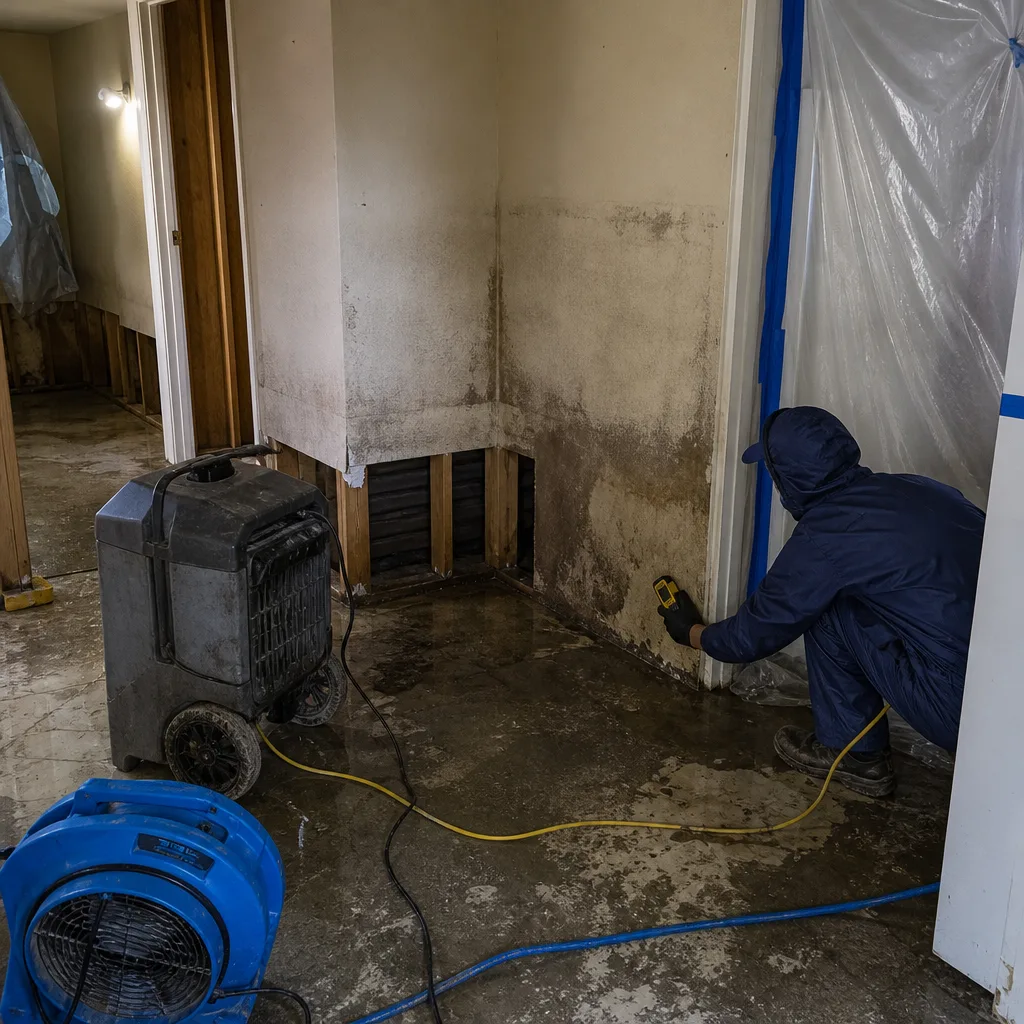
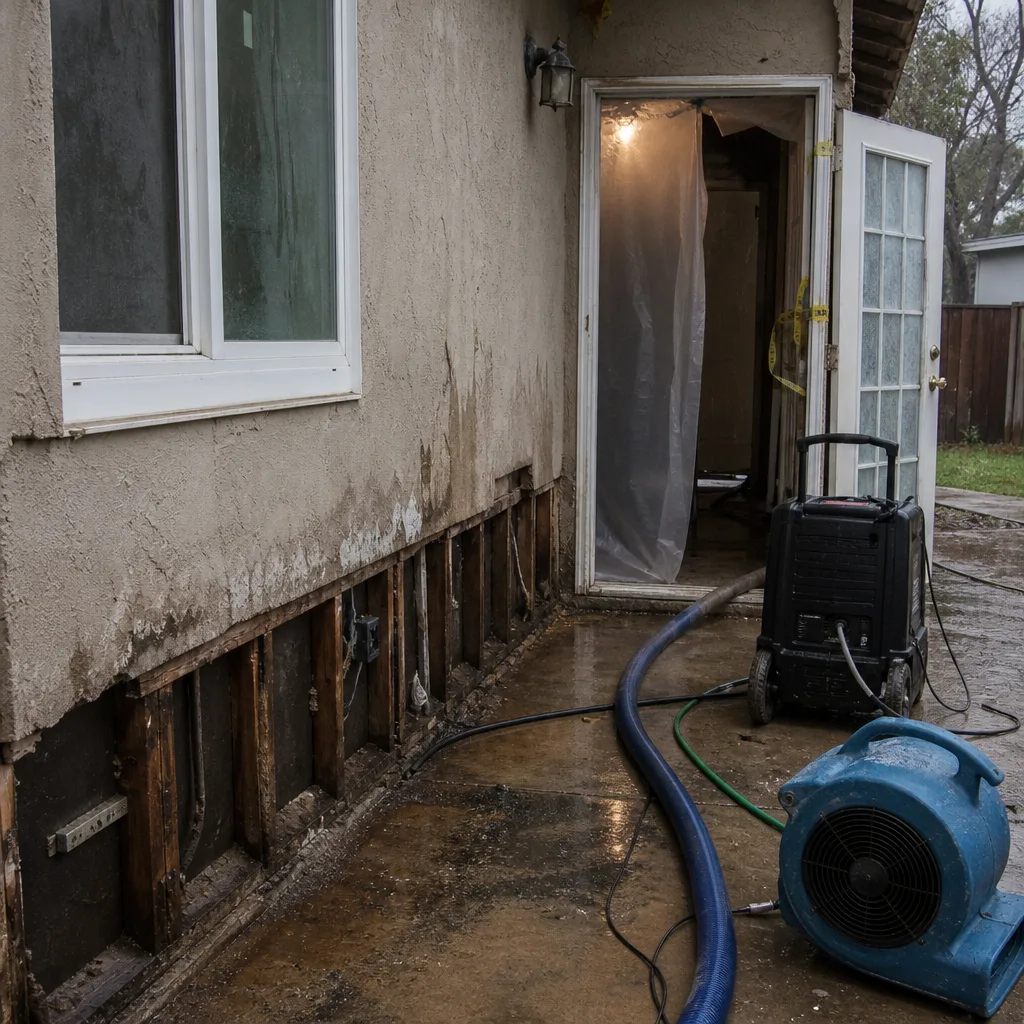
- Extraction. Standing water is removed with extraction equipment. For large losses, a truck-mounted extractor moves water at several hundred gallons per minute, far beyond what any portable unit can manage. For smaller jobs or hard-to-reach areas, portable extraction units and Injectidry systems pull water from wall cavities without tearing out the drywall.
If your restoration company shows up without the ability to test moisture, set containment, and extract at commercial scale, you’re not getting mitigation. You’re getting a cleanup visit. The two look similar in the first 20 minutes, but the outcomes diverge dramatically after 72 hours.
Phase 2: Structural Drying and Psychrometric Science (Hours 4-72)
After extraction, the real work begins. A structure looks dry long before it is dry. Concrete, hardwood, drywall, and insulation all hold moisture below the surface. The only way to know when a building is actually dry is to measure it with psychrometric readings: temperature, relative humidity, and grains per pound (GPP), the actual weight of moisture in the air. This is the difference between documented drying and guesswork.
A certified technician calculates a drying goal for each affected material based on the type of material and the normal moisture content for that material in San Bernardino’s climate. The goal is not zero moisture. Wood in a living space in Southern California typically rests around 8-10% moisture content. Drying it further than that causes cracking and shrinking. The science is about hitting the target, not cranking the dial.
The equipment setup follows the drying goal:
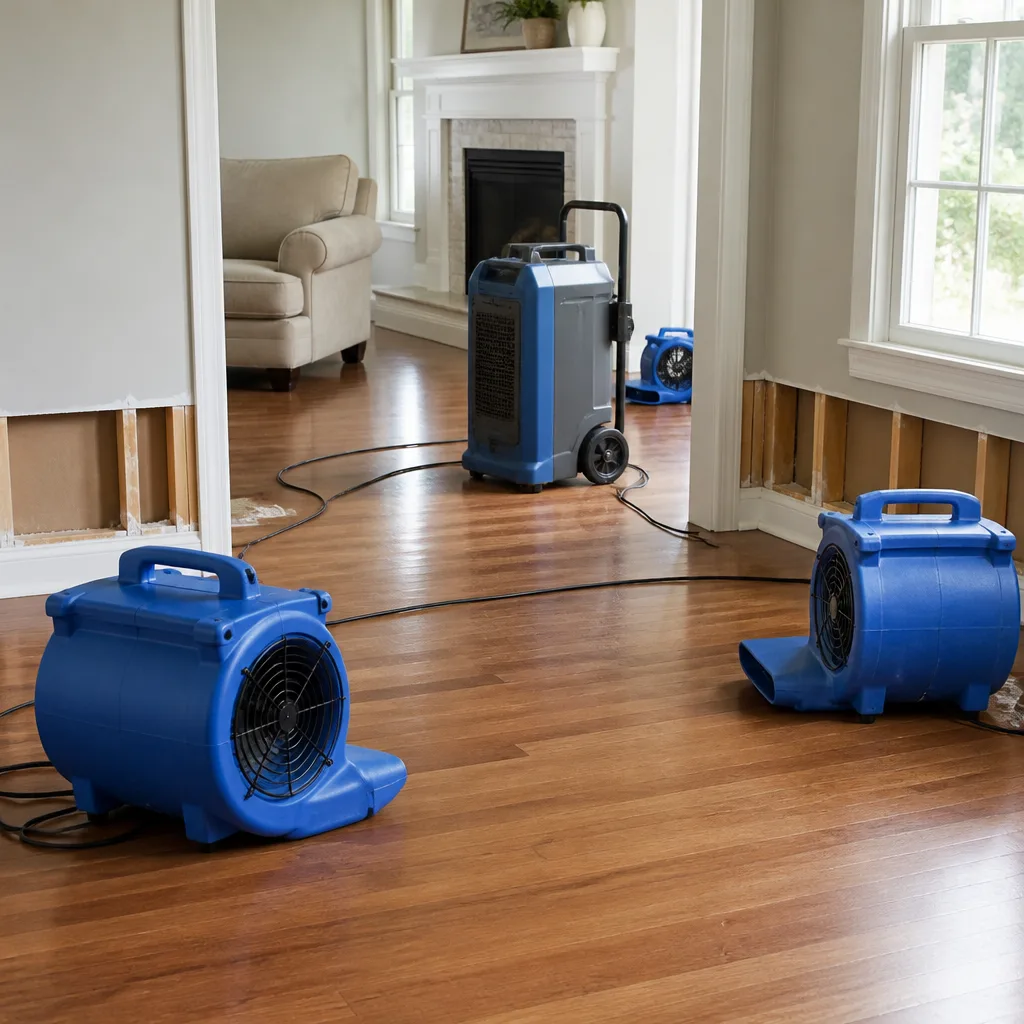
- LGR (Low Grain Refrigerant) dehumidifiers from Dri-Eaz and Phoenix pull moisture out of the air at a rate standard dehumidifiers can’t approach. LGR units keep pulling water down to very low humidity levels, which is what draws moisture out of materials like concrete and hardwood.
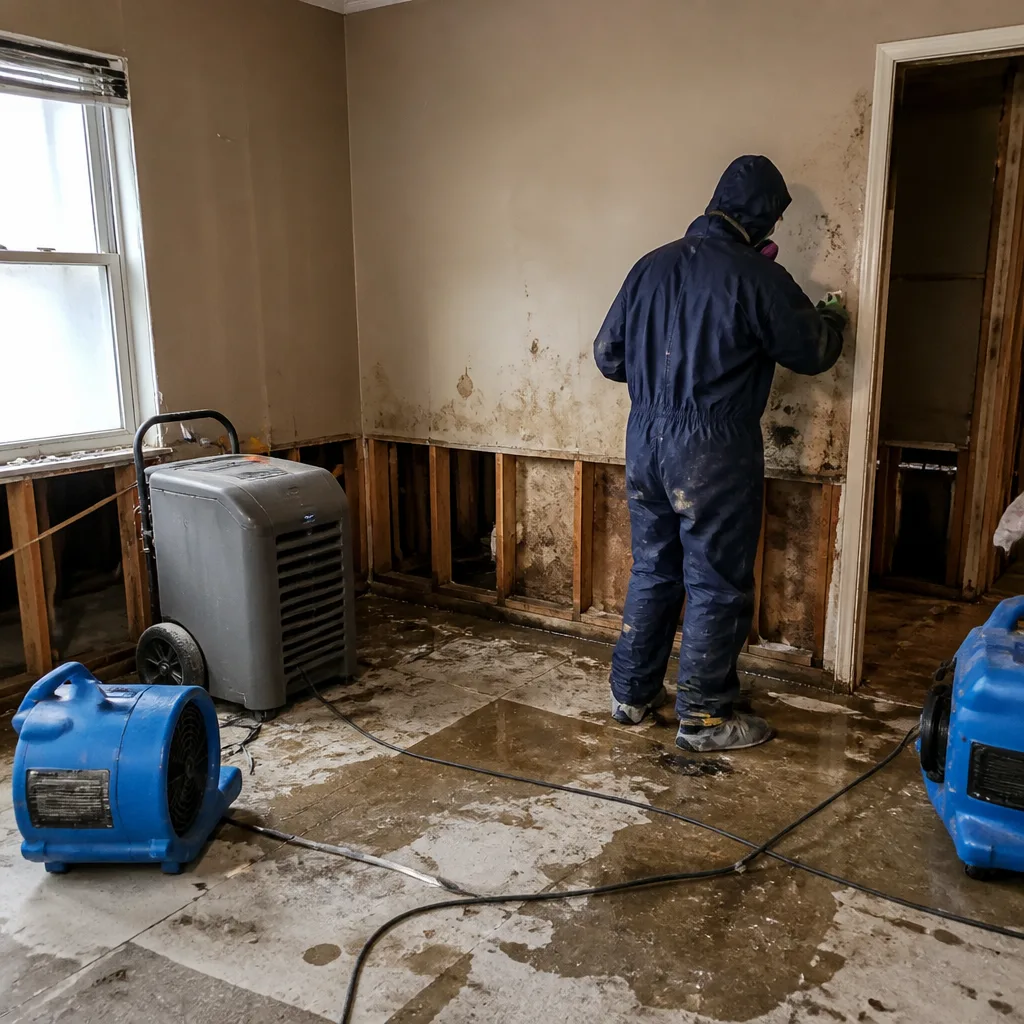
- Axial air movers from XPOWER and B-Air create the airflow that lifts moisture off surfaces and into the air, where the dehumidifier removes it. The number and placement of air movers is calculated based on square footage and the amount of water absorbed, not scattered around until it “feels right.”
- Injectidry systems force dry air into wall cavities, under cabinets, and beneath flooring without removing the materials. This is the technology that saves walls and floors that would otherwise be torn out and replaced. It’s slower than demolition in the first 24 hours, but it’s far less invasive and far less expensive for the homeowner.
Daily readings go into a drying log. When the readings hit the established drying goal for two consecutive days, the structure is documented dry. That log, with the readings and the date stamps, is one of the core pieces of evidence an insurance adjuster looks for when reviewing a claim. It’s what proves the drying was done correctly, not just that it looked dry.
Phase 3: Mold Remediation and Smoke Cleaning
Mold doesn’t need standing water. Mold needs moisture, a food source, and time. Drywall paper, wood framing, and carpet backing are food. A damp wall cavity after a slow leak is a perfect environment. In San Bernardino’s warm climate, mold can begin colonizing within 48 to 72 hours of a moisture event. By the time you see black staining on a baseboard, the colony has often been growing for weeks behind the wall.
S520, the IICRC standard for mold remediation, defines a clear protocol:
- Assessment and source correction. You can remove mold all day, but if the moisture source is still active, it will return. The source leak gets fixed first, always.
- Containment. The affected area is sealed with plastic sheeting and placed under negative air pressure so disturbed spores don’t spread to other rooms. This is the step that separates professional remediation from someone scrubbing with bleach. Bleach kills surface mold but doesn’t address the roots inside porous materials, and the scrubbing itself sends spores into the air.
- Removal and cleaning. Porous materials with deep mold penetration are removed and bagged. Non-porous surfaces like tile and metal are cleaned with antimicrobial treatments. Semi-porous materials like wood studs are HEPA vacuumed and sanded when possible.
- Drying and clearance testing. The area is dried to the same psychrometric standards as water damage work, then cleared with air and surface samples that show fungal levels have returned to normal background range.
Mold remediation in San Bernardino carries an extra urgency because of the valley’s heat. Warm temperatures accelerate mold growth, which compresses the timeline for action. A minor mold problem in a damp crawl space in January becomes a major one by March. Our Mold Remediation in San Bernardino guide covers the full process, including what clearance testing actually measures.
For fire and smoke damage, the cleaning phase is chemistry-heavy. Different surfaces absorb smoke differently. Oily residue requires different chemistry than dry soot. Acidic smoke from burning synthetics will etch glass and tarnish metal if not neutralized quickly. Ozone and hydroxyl generators break down the odor molecules rather than masking them. Any company that suggests painting over smoke damage with a sealing primer before the underlying char and residue is cleaned is skipping a phase. That primer will peel, and the odor will return.
Phase 4: The Handoff to Reconstruction and Why Two Companies Create Liability Gaps
Here’s where many San Bernardino homeowners get burned financially. Mitigation and remediation are one discipline. Reconstruction is another. They require different skills, different equipment, and different licensing. But when they’re handled by two separate companies with no communication, the handoff becomes a game of “who’s responsible for this?”
We see it regularly. A mitigation company dries a structure, documents the dry-out, and hands the homeowner a report. A reconstruction company comes in, replaces the drywall and flooring, and says they’re not responsible for anything the mitigation company missed. Six months later, a mold smell returns. The mitigation company says the reconstruction company didn’t install vapor barriers correctly. The reconstruction company says the mitigation company didn’t dry the structure fully. The homeowner is in the middle, and the insurance claim is closed.
When a single specialized team owns the full damage restoration sequence, from extraction to clearance to rebuild, that liability gap doesn’t exist. The same company that took the moisture readings is the company that rebuilds the wall. If the wall fails, there’s no finger-pointing. There’s just a warranty call.
The alternative, piecing together three contractors from Yelp, creates three separate scopes, three invoices, and three parties with an interest in blaming the others when something goes wrong. In our experience, the “coordination gap” is where most secondary damage claims originate. Someone thought someone else tested for moisture. Someone assumed someone else removed the wet insulation. Assumption is not a restoration protocol.
What Equipment Should Be On-Site and Why the Ratio Matters
Here’s something most damage restoration content never tells you: the equipment your restoration company brings determines the outcome as much as the technician’s skill does. You cannot dry a flooded home correctly with consumer-grade fans and a rental dehumidifier from a hardware store. The capacity simply isn’t there.
Professional restoration requires professional-tier equipment. The brands you should see on a San Bernardino job site are the same machines used on large commercial losses:
- Truck-mounted extractors for large water losses. These units connect to the vehicle’s engine and pull water at rates that make a portable unit look like a straw. For a flooded basement or a slab leak that’s been running for days, this is the only extraction method that gets water out fast enough to limit structural absorption.
- LGR dehumidifiers from Dri-Eaz and Phoenix. Low grain refrigerant technology pulls moisture down to levels standard refrigerant dehumidifiers can’t reach. In a San Bernardino summer, when the air outside is already dry, a standard dehumidifier might seem adequate. But the moisture isn’t in the air. It’s in the slab, the drywall, and the flooring. Only LGR units create the vapor pressure differential that draws water out of dense materials.
- Axial air movers from XPOWER and B-Air. These are not box fans. They move air in a focused stream that creates evaporation at the surface level. The number of air movers per square foot, and their position relative to wet walls and floors, is calculated based on the class of water loss. Get the ratio wrong and drying times double, even triple.
- Injectidry systems for wall cavities and under-cabinet drying. Without this technology, drying inside a wall means cutting holes or removing drywall entirely. Injectidry hoses attach to small access points and force dry air through the cavity. The structure dries in place, and the homeowner avoids thousands of dollars in unnecessary demolition and replacement.
If a restoration company shows up with a pickup truck full of box fans and a single dehumidifier, that’s not a professional restoration setup. That’s a homeowner’s weekend project with a logo on the truck. The equipment tells you everything about the level of work you’re going to get.
Insurance Documentation: What an Adjuster Needs to See
Most homeowners in San Bernardino never see the inside of an insurance claim until they have to. And then they discover that the paperwork is part of the restoration process. The documentation your restoration company produces is what determines whether your claim gets paid in full, partially, or denied.
A documented restoration file includes:
- Initial moisture readings taken at the first visit, showing the affected areas and the moisture content of each material. Without these baseline readings, there’s no proof the damage existed when you said it did.
- Photo documentation of the damage before, during, and after mitigation. Adjusters can’t see what’s already been removed. The photos are the evidence.
- Drying logs with daily psychrometric readings showing the structure moving toward the drying goal. These logs prove the mitigation was done correctly and the structure was verified dry before reconstruction began.
- Scope documentation for any demolition, remediation, or reconstruction work. A clear written scope, agreed to before work starts, is what protects you from being oversold once a crew is inside the house.
- Clearance testing results for mold remediation, showing fungal levels have returned to normal background range.
Insurance adjusters work with specific documentation requirements. If your restoration company can’t produce psychrometric readings, drying logs, and photo evidence, your claim becomes a negotiation based on he-said-she-said. And in our experience, the homeowner doesn’t win those. The adjuster has a checklist. The restoration company should be able to fill every line on it without being asked.
Common Mistakes to Avoid
- Waiting to see if it “gets better.” Damp drywall does not self-correct. In San Bernardino’s heat, the surface dries fast, which creates the illusion that the problem is resolving while moisture moves deeper into the structure. Within 72 hours, mold colonies are forming inside wall cavities. The window for extraction and minimal-damage drying closes fast.
- Using a general handyman for water mitigation. A handyman can patch drywall and paint. A handyman cannot calculate a drying goal, set a proper drying chamber, or document psychrometric readings that insurance adjusters need. The work looks similar in the first day and diverges dramatically after that.
- Skipping containment during mold removal. Scrubbing moldy drywall without containment sends spores into the air, and from there into HVAC systems and every other room. What started as a bathroom mold problem becomes a whole-house mold problem because the remediation wasn’t done under S520 protocols.
- Letting the reconstruction company start before the structure is documented dry. Sealing a wall that hasn’t been verified dry is how you get a mold problem that returns six months later. The drying log is the document that proves readiness for rebuild. No drying log, no reconstruction work.
- Accepting a verbal scope instead of a written one. A verbal agreement about what will be cleaned, removed, or rebuilt is worthless when the invoice arrives. A written scope, agreed to before work starts, is the only thing that protects you from overselling and scope creep.
- Assuming the insurance company will catch every detail. Adjusters are busy and often working from checklists. If your restoration company doesn’t document properly, the claim gets underpaid. The documentation is your insurance insurance.
- Choosing based on price alone. The cheapest restoration company in San Bernardino is cheap because they’re cutting corners somewhere, usually equipment or documentation. The most expensive part of restoration is doing it twice.
When to Call a Professional
Any water event that involves more than a mop’s worth of water, any visible mold growth larger than about 10 square feet, or any fire that leaves smoke residue on surfaces warrants a professional call. That’s not being cautious; that’s recognizing that building materials hold moisture and contamination in ways that surface cleaning can’t address. If you can see water staining on a wall or ceiling, the visible part is the small part. The moisture has traveled further than the stain. If you smell mold, there’s a colony active inside the structure, not a surface issue that a bleach spray will handle. For damage restoration emergency preparedness in San Bernardino, call San Bernardino Restoration Co for free estimates at (877) 358-7678. A phone call costs you nothing, and the worst case is that you learn your problem is smaller than you thought. The best case is that you catch a growing issue before it becomes a structural one.
Frequently Asked Questions
Water damage mitigation typically takes 3 to 5 days for the drying phase, with reconstruction adding 1 to 4 weeks depending on the extent. Mold remediation usually runs 3 to 7 days including clearance testing. Fire and smoke damage restoration can take 2 to 8 weeks depending on whether structural rebuild is needed. The timeline in San Bernardino is often compressed by the heat, which speeds drying but also accelerates mold growth, making the first 72 hours the most critical.
Most homeowner policies cover sudden and accidental water damage, fire damage, and mold remediation when the mold results from a covered water event. Mold from long-term humidity or deferred maintenance is often excluded. Your restoration company’s documentation, the moisture readings, drying logs, and photos, is what proves to the adjuster that the damage is covered and the work was done correctly. Call (877) 358-7678 and we can walk you through what your claim needs.
Consumer-grade equipment cannot pull water from building materials the way LGR dehumidifiers and axial air movers can. You’ll dry the surface, and the moisture below it will remain, creating the conditions for mold and structural damage. By the time the problem is visible, the repair cost is significantly higher than professional mitigation would have been from the start.
IICRC certification means the technician has completed standardized training and passed exams administered by the Institute of Inspection, Cleaning and Restoration Certification, the governing body for the restoration industry. Certified technicians are tested on the S500 water damage standard and S520 mold remediation standard, which define the protocols for proper extraction, drying, containment, and clearance. It’s the difference between following a science-based protocol and improvising.
The structure is dry when psychrometric readings, temperature, relative humidity, and grains per pound, hit the drying goal established for each material and hold there for two consecutive days. Visual inspection is not a drying measurement. Drywall can look and feel dry to the touch while holding 25% moisture content. Only documented readings prove the structure is ready for reconstruction.
You don’t, if your water damage company is IICRC-certified in both water and mold protocols. The S500 and S520 standards are related but distinct. A company that handles both under one roof, with certified technicians for each, eliminates the coordination gap between the drying company and the mold company. If you’re hiring separate firms, you become the project manager, and any gap between their scopes of work becomes your problem.
The Bottom Line
Damage restoration in San Bernardino is not one event. It’s a sequence of phases, extraction, drying, remediation, and rebuild, that each depend on the phase before them being done correctly. The majority of secondary damage in this city happens because a phase was skipped, rushed, or never documented. Santa Ana winds, clay soil, and hard water make San Bernardino’s damage profile different from other Southern California cities, which means restoration decisions should be made with local knowledge, not generic advice. Hiring a company with IICRC-certified technicians, professional-grade equipment from Dri-Eaz, Phoenix, XPOWER, B-Air, and Injectidry, and the ability to document every phase for your insurance claim is the difference between a complete recovery and a problem that comes back after the claim is closed.
Written by the team at San Bernardino Restoration Co, serving San Bernardino since 2016.
See the difference
 Before
 After
 Before
 After
 Before
 After